No Results Found
The page you requested could not be found. Try refining your search, or use the navigation above to locate the post.



‘Let them deny themselves and take up their cross and follow me’
Jesus makes it very clear that following him appears costly – if you measure it in human terms. The call to self-denial would seem to be the complete opposite of the animal instinct of survival of the fittest – that life is a competition for food, comfort and power that only the strongest can win. Although the proponents of what is called a ‘Prosperity Gospel’ would subscribe to such a way of life, it doesn’t look to be ‘self-denying’ – ‘self-important and self-centred’ would be closer to the case.
On the other hand, typically, as humans tend to do, the exercise of self-denial is often taken to the extreme, becoming self-punishment. Extended fasting, Hair shirts, self-mortification and suchlike are seen as ways to purge a sinful nature – the more self-deprived, the closer to God. Except that, in a way, that too can be equally self-centred – you might call it ‘competitive humility’.
I believe that what Jesus is asking is the recognition of equality with all His people – with the consequence that the needs of others are to be placed before ones own. Essentially, following Jesus – denying oneself – is living in servanthood. And true servanthood isn’t painful at all – it offers a different kind of life altogether, one I which the only ‘cost’ is a release from the constant (and ultimately unfulfillable) pressure to achieve ‘success’ in an increasingly material and competitive world.
History from the dawn of time proves that victory is impossible to achieve through force and domination over others. Perhaps it is time for the world to try Servant Love – love of our neighbour, whoever she or he may be. After all, that’s what Jesus asks of us – the reward being a closer walk with Him.
Previous Posts
The page you requested could not be found. Try refining your search, or use the navigation above to locate the post.


The LORD God sent Adam forth from the garden of Eden, to till the ground from which he was taken. He drove out the man; and at the east of the garden of Eden he placed the cherubim, and a sword flaming and turning to guard the way to the tree of life.
The LORD said to Abram, ‘Go from your country and your kindred and your father’s house to the land that I will show you.
A man shall leave his father and mother and be joined to his wife.
And Jesus came and said to them, ‘All authority in heaven and on earth has been given to me. Go therefore and make disciples of all nations, baptizing them in the name of the Father and of the Son and of the Holy Spirit, and teaching them to obey everything that I have commanded you. And remember, I am with you always, to the end of the age.’
Life is a process of continual change – some gradual, some more dramatic. Perhaps marriage, parenthood, retirement, serious illness, facing the inevitability of growing old. However excited and confident we may feel, deep down, there is always too a slight sense of uncertainty as we approach any significant lifestyle change. And this is the time of the year when many young people are stepping out into a new chapter of life – first day at school or college, perhaps a first job – and as parents, we try to disguise our feelings of concern as we realise that we have to trust them to the Lord and let go.
Scripture is full of stories of coming and going – life-changing journeys that affect each one of us everyday. We each have our own stories of departures – some joyous, some sad (Often both at the same time!). We learn that whenever we go to somewhere new, we run the risk of getting lost unless we take a map, and, like Theseus, make sure we have a way to find the way back home to security in case we’ve taken a wrong turning.
Fortunately, we do have a map. We have a compass We have learned from our experiences. We are taught by our memories. We have a home with the light left burning. We have our Bible. We have our counsellor. We have a home in Heaven. We have Jesus.
As we move on, we do so in In Him, with faith, hope and love. And thus all shall be well, and all shall be well, and all manner of thing shall be well.
So, a song for all the Mothers, Fathers, Grandmas and Grandads who are waving a farewell and praying God speed as they watch their children step out in excitement and hope at their new beginning. May the Lord Bless them and keep them safe. And you too, in your journeys.
Previous Posts
The page you requested could not be found. Try refining your search, or use the navigation above to locate the post.
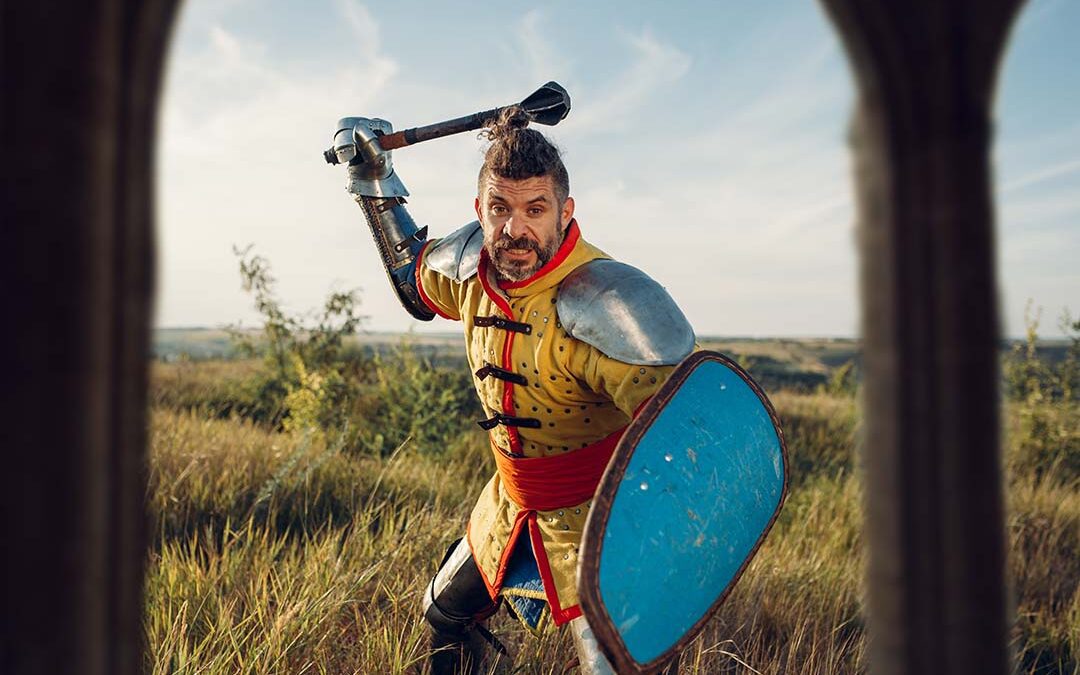
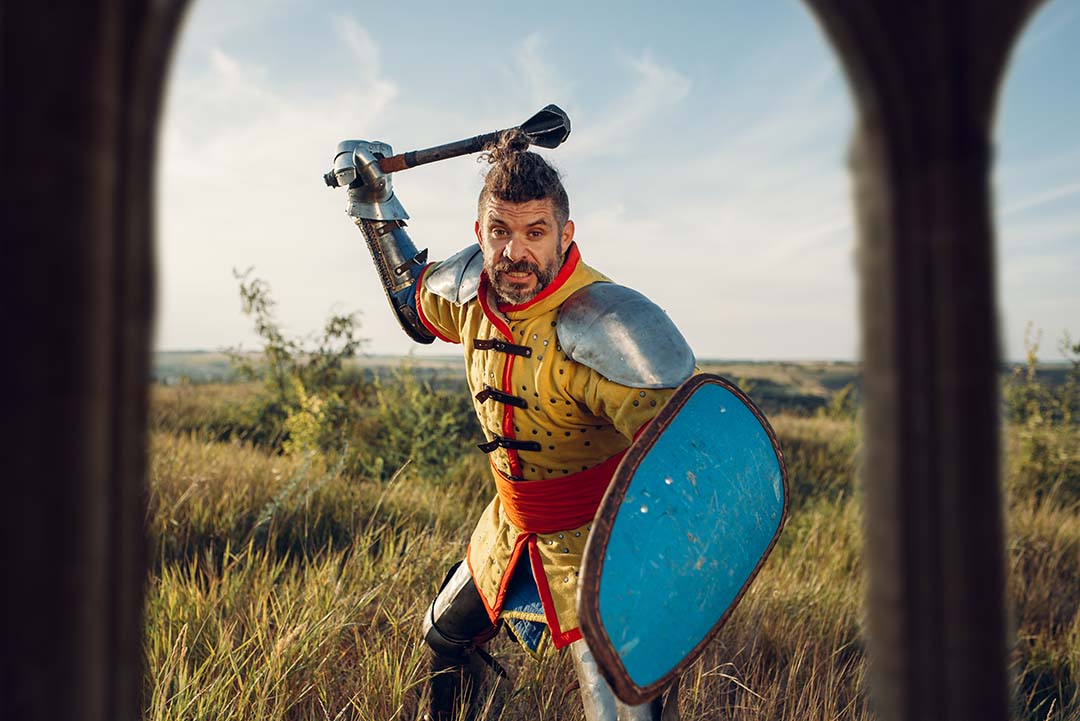
I looked on the Internet for an image relevant to Paul’s instructions on defending against the spiritual forces of evil. Ther are many of them. They invariably depict a warrior clad in medieval armor (sic), a modern-day Ivanhoe ready to fight a holy war. Dramatic. But completely missing the point.
Victory in battle may be temporarily won by military might. But in the longer term, force rarely (if ever) sustains. Napoleon Buonaparte was well aware of that. “Alexander, Caesar, Charlemagne, and I have founded empires. But on what did we rest the creations of our genius? Upon force. Jesus Christ founded his empire upon love; and at this hour millions of men would die for him.”
Violence achieves nothing towards bringing in the Kingdom of God. All it does is engender more violence. God wins the War through sacrifice – the sacrifice of His Son.
Paul uses the metaphor of armour – but he isn’t talking about the weapons of violence. Instead, he calls for Truth. Righteousness. Peace. Faith. Salvation. The word of God. And through these, the War is won.
A short battle, it was;
no flags and no trumpets,
not a fair fight.
One naked man with outstretched arms
against chain mail and spears.
They gave Him thorns,
gave Him whips,
gave Him sour wine and their spittle,
gave Him nails… but gave Him no honour.
It’s over now.
He dies alone, and the quiet is hard to bear.
Even the banter of the soldiers is hushed;
only the sound of the wind and the aching world,
bound and fearful for so long,
waiting for its freedom.
Funny kind of battle, it was;
one man against legion.
Funny kind of victory
when the victor dies.
I wonder if the loser knew;
I wonder if the shaking of the earth
or the tearing of the curtain distracted him?
Or did he see, and despair to see,
the Christ-blood
washing the earth beneath the cross?
Funny when a victory’s won by seeming loss.
Previous Posts
The page you requested could not be found. Try refining your search, or use the navigation above to locate the post.


I am the living bread that came down from heaven. Whoever eats of this bread will live for ever; and the bread that I will give for the life of the world is my flesh.’
*****
Do not neglect to show hospitality to strangers, for thereby some have entertained angels unawares.
Hebrews 13:2
You will notice that Jesus tells the inquisitorial Jews that He doesn’t differentiate between anyone who confesses His name. ‘Those who eat my flesh and drink my blood abide I me, and I in them’. All those. Whoever.
Paul expands on the same theme in Galatians 3:28 ‘There is neither Jew nor Greek, there is neither slave nor free, there is neither male nor female; for you are all one in Christ Jesus.’
No ifs or buts. We are all one. Whoever, wherever. One family in Christ, even those who are not of the sheepfold, and those who unknowingly offer food, drink, clothes to the needy in His name.
It is certainly true that showing apparent never-ending hospitality is difficult in an environment where there are increasing numbers of refugees, and people of goodwill are understandably concerned. However there are also those – even some who loudly claim that they profess a faith – who clearly seek to foster hate and broken relationships, usually for their own ends. Yet scripture makes it clear that there is no place in the Kingdom for any who would wish to exacerbate division.
Yes, immigration is an issue. But the issue should be about how to make it possible for people under threat to find safety. There is no getting away from the fact that we are clearly commanded to welcome the stranger, the outcast, and doing so will probably have an effect on our lifestyle. But I can find nowhere in Scripture that suggests that my own comfort should take priority over offering help and support to those in need.
It’s no good saying ‘There’s no room’. Even if true (which it actually isn’t), we’d make plenty of space if it were our children who had no place of safety. Or even, perish the thought, if it were we ourselves seeking shelter.
The challenge of Emma Lazarus’ sonnet ‘The New Colossus’ is not restricted to the plaque on the Statue of Liberty – it applies to all of us, and it is not too long ago when the Irish ourselves found it to be a promise of hope in its expression of welcome in the face of famine and injustice.
“Keep, ancient lands, your storied pomp!” cries she
With silent lips. “Give me your tired, your poor,
Your huddled masses yearning to breathe free,
The wretched refuse of your teeming shore.
Send these, the homeless, tempest-tost to me,
I lift my lamp beside the golden door!”
Previous Posts
The page you requested could not be found. Try refining your search, or use the navigation above to locate the post.


O God, you demonstrate your almighty power most clearly in showing mercy and pity: Mercifully grant to us such a measure of your grace, that we, seeking to obey your commandments, may receive your gracious promises, and be allowed to share your heavenly treasure; through Jesus Christ our Lord.
How to win Olympic Gold:
Eat. Be aware of your food, where it comes from, what it contains. Optimise your diet. Eat noting that doesn’t help your fitness.
Train. Realise the unique gifts you have been given and aim to develop them through understanding how to grow and refine those gifts.
Practice. Even though we often hear the phrase ‘Practice makes perfect, it doesn’t. Only perfect practice makes perfect. Have a schedule, have a purpose and a target. It may demand sacrifices, it will undoubtedly hurt. Rise above the barriers and focus on the finish line.
Act. Unless the above is applied in the critical moments when it matters, it will have been a waste of time. Be ready always for the sound of the starting pistol.
Recover. Sometimes you will win the race, many times you will not. When you fail, pick yourself up, dust yourself down, and start all over again.
How to win the Gold medal for being the special. unique person God created:
Eat. I am the bread of life, says Jesus. Unless you eat of this bread, you shall not have life within you. John 6:35
Train. Read your Bible and use commentaries to assist understanding. Listen to teachers and others who have gone before. Pray. 2 Timothy 3:16
Practice. Exercise a spiritual discipline, and try to identify God’s call and seek the Spirit’s guidance. Matthew 7:7
Act. Serve. Put your words into action. James 1:22-25
Recover. Take your failures and your sins to the foot of the Cross – and leave them there! Matthew 11:28-29
An athlete’s prayer
God, let me play well but fairly.
Help me to learn something that matters
once the game is over.
Let competition make me strong but never hostile.
Always let me help my opponent up.
Never catch me rejoicing in the adversity of others.
If I know victory, allow me to be happy; if I am denied, keep me from envy.
Remind me that sports are just games.
If through my behaviour I set an example,
let it be a good one.
Previous Posts
The page you requested could not be found. Try refining your search, or use the navigation above to locate the post.