Rev Michael Cavanagh +353 (0)87 160 6312
Praying Together 22nd February 2026

Praying Together 22nd February 2026

So the commandment is a challenge. To love those who betray you. Those who jeer. Those who wield the whips embedded with flint, hammer in the nails, pierce your side.

Lent 1 2026

Collect

Almighty and everlasting God, you hate nothing that you have made and forgive the sins of all those who are penitent: Create and make in us new and contrite hearts that we, worthily lamenting our sins and acknowledging our wretchedness, may receive from you, the God of all mercy, perfect remission and forgiveness; through Jesus Christ our Lord.

Genesis 2: 15-17, 3: 1-7

15 The Lord God took the man and put him in the garden of Eden to till it and keep it. 16And the Lord God commanded the man, ‘You may freely eat of every tree of the garden; 17but of the tree of the knowledge of good and evil you shall not eat, for in the day that you eat of it you shall die.’

3Now the serpent was more crafty than any other wild animal that the Lord God had made. He said to the woman, ‘Did God say, “You shall not eat from any tree in the garden”?’ 2The woman said to the serpent, ‘We may eat of the fruit of the trees in the garden; 3but God said, “You shall not eat of the fruit of the tree that is in the middle of the garden, nor shall you touch it, or you shall die.” ’ 4But the serpent said to the woman, ‘You will not die; 5for God knows that when you eat of it your eyes will be opened, and you will be like God,* knowing good and evil.’ 6So when the woman saw that the tree was good for food, and that it was a delight to the eyes, and that the tree was to be desired to make one wise, she took of its fruit and ate; and she also gave some to her husband, who was with her, and he ate. 7Then the eyes of both were opened, and they knew that they were naked; and they sewed fig leaves together and made loincloths for themselves.

Reflection

If God didn’t want them to eat from the tree of Knowledge of good and evil, why did He put it there in the first place?

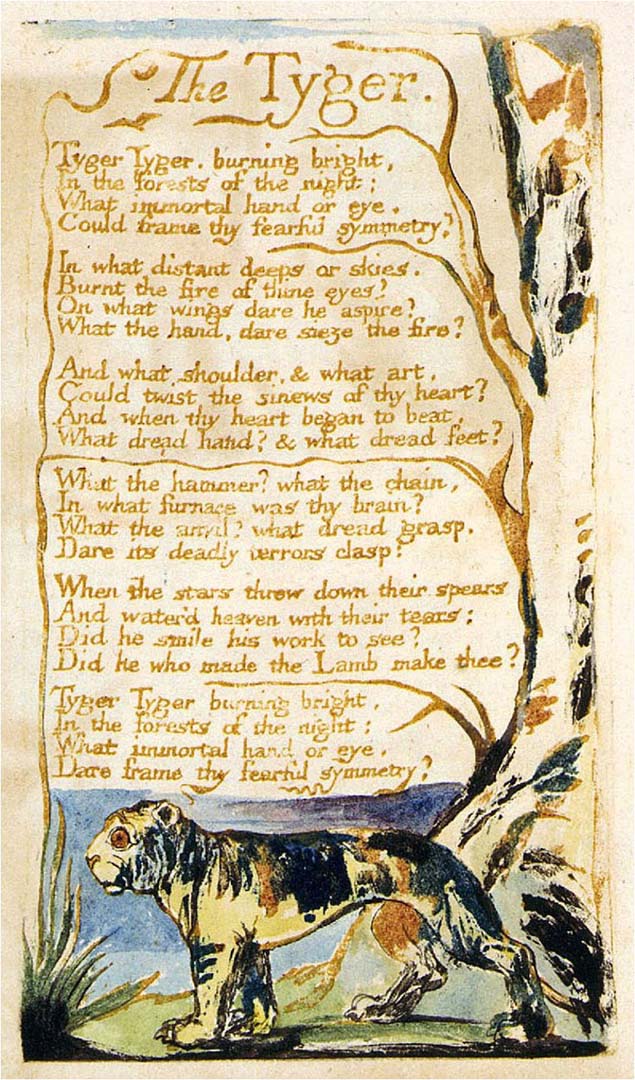
Did He who made the lamb make thee?

Good questions. In fact, the same question and the same answer. We recognise the qualities of things in terms of opposites. Tree of Knowledge of good and evil. A fierce Tyger and a meek and gentle lamb. Safe things and dangerous things. War and Peace. Why does a loving God allow the possibility of evil? Why not make sure everything is nice and safe all the time?

The answer is that He had to. If we are to appreciate the gentleness of a lamb, we need to know its opposite. If we are to understand what safety is, we need also to experience the possibility of danger. Peace means nothing if war doesn’t exist. If we are to know freedom, we need to know imprisonment. So, if there is to be ‘good’, the existence of ‘evil’ is inevitable.

If we don’t have the ability to choose between the two, we are just puppets with no free will, living in a Utopia we aren’t even aware of. God wants us to be human, with all that humanity entails, good and bad. And that means, painful as it was, He had to let Eve and Adam have the opportunity to decide. In a sense, the serpent was an instrument of God’s intention.

Eve and Adam chose to leave the Garden. They could have stayed. The serpent didn’t force them out – they were simply faced with having to make a moral decision, and they got it wrong. But at least they had that choice.

The ability to choose was a gift. But when they ate the poisoned fruit of human evil, God wasn’t about to desert them. His love extended to a second gift – forgiveness and redemption. It cost Him Himself, on the Cross. When we make choices, let His passion be our guide

Previous Posts

Praying Together 15th February 2026

Praying Together 15th February 2026

So the commandment is a challenge. To love those who betray you. Those who jeer. Those who wield the whips embedded with flint, hammer in the nails, pierce your side.

Sunday before Lent

Collect

Almighty Father, whose Son was revealed in majesty before he suffered death upon the cross: Give us grace to perceive his glory, that we may be strengthened to suffer with him and be changed into his likeness, from glory to glory; who is alive and reigns with you and the Holy Spirit, one God, now and for ever.

Matthew 17: 1-9

After six days Jesus took with him Peter, James and John the brother of James, and led them up a high mountain by themselves.

2 There he was transfigured before them. His face shone like the sun, and his clothes became as white as the light.

3 Just then there appeared before them Moses and Elijah, talking with Jesus.

Peter said to Jesus, “Lord, it is good for us to be here. If you wish, I will put up three shelters—one for you, one for Moses and one for Elijah.”

5 While he was still speaking, a bright cloud covered them, and a voice from the cloud said, “This is my Son, whom I love; with him I am well pleased. Listen to him!”

6 When the disciples heard this, they fell facedown to the ground, terrified. 7 But Jesus came and touched them. “Get up,” he said. “Don’t be afraid.” 8 When they looked up, they saw no one except Jesus.

9 As they were coming down the mountain, Jesus instructed them, “Don’t tell anyone what you have seen, until the Son of Man has been raised from the dead.”

Reflection

Two transfigurations?

The gospel story of the Transfiguration in Matthew 17 provides many opportunities for exposition.

17:2 has parallels with Exodus 34:29, when Moses returns from talking with the Lord, his face radiant with the light he has seen with his own eyes – God’s real presence becoming visible.

In 17:3, we could discuss the link between Old and New Testaments – the fulfilment of the Law given to Moses, and the promise of a Redeemer as prophesised by Elijah, being filled by the Messiah.

In 17:4, Peter’s all too human response is a request for permanence, a desire to hold on to the Mountaintop experience for ever.

In 17:5&6, God commands an acceptance of Jesus’ authority with such power that the disciples are terrified.

17:7 records Jesus’ encouragement that they should not be afraid but inspired them and reassures them to be fearless in the events that are to happen – that His power will overcome the world.

In 17:8, short as the experience might be, it will be burnt into their memory and they too will carry the reflected light with them in their future ministries.

In later years Paul will describe his own personal experience of meeting Christ in 2 Corinthians 3:18 – And we all, who with unveiled faces contemplate the Lord’s glory, are being transformed into his image with ever-increasing glory

In all of this, the Transfiguration – when Jesus the human is recognised as divine – is often described as the meeting place of the temporal and the eternal. But let me suggest that our interpretation of this massive, life shattering meeting might sometimes get it the wrong way round.

Perhaps the Mountaintop Transfiguration – the metamorphosis, the change – is actually in the believer’s eyes as, for the first time, they see the changeless Jesus as he is, was before the world was made, and will be when the New Jerusalem descends; His Earthly Transfiguration having happened at the moment of incarnation, when the divine became a human being.

Malachi 3:8 – He changeth not. Rather, it is in our belief that we, with unveiled faces, are changed forever. Perhaps, when we pray, we need to remember it is the Jesus on the Mountain to whom we address our prayers, the one whose face shines like the sun and transfigures our faces as we radiate in His light.

Turn Your Eyes Upon Jesus (Church Online) – Hillsong Worship

Previous Posts

Praying Together February 8th 2026

Praying Together February 8th 2026

So the commandment is a challenge. To love those who betray you. Those who jeer. Those who wield the whips embedded with flint, hammer in the nails, pierce your side.

The Second Sunday before Lent

Consider the lilies of the field, how they grow…

Collect

Almighty God,
you have created the heavens and the earth and made us in your own image:

Teach us to discern your hand in all your works and your likeness in all your children; through Jesus Christ our Lord, who with you and the Holy Spirit
reigns supreme over all things, now and for ever.

Corinthians 4: 1-12

Think of us in this way, as servants of Christ and stewards of God’s mysteries.

Moreover, it is required of stewards that they should be found trustworthy. But with me it is a very small thing that I should be judged by you or by any human court. I do not even judge myself. I am not aware of anything against myself, but I am not thereby acquitted. It is the Lord who judges me.

Therefore do not pronounce judgement before the time, before the Lord comes, who will bring to light the things now hidden in darkness and will disclose the purposes of the heart. Then each one will receive commendation from God.

Matthew 6: 24-34

‘No one can serve two masters; for a slave will either hate the one and love the other, or be devoted to the one and despise the other. You cannot serve God and wealth.*

‘Therefore I tell you, do not worry about your life, what you will eat or what you will drink,* or about your body, what you will wear. Is not life more than food, and the body more than clothing? Look at the birds of the air; they neither sow nor reap nor gather into barns, and yet your heavenly Father feeds them. Are you not of more value than they? And can any of you by worrying add a single hour to your span of life?* And why do you worry about clothing? Consider the lilies of the field, how they grow; they neither toil nor spin, yet I tell you, even Solomon in all his glory was not clothed like one of these. But if God so clothes the grass of the field, which is alive today and tomorrow is thrown into the oven, will he not much more clothe you—you of little faith? Therefore do not worry, saying, “What will we eat?” or “What will we drink?” or “What will we wear?”

For it is the Gentiles who strive for all these things; and indeed your heavenly Father knows that you need all these things. But strive first for the kingdom of God* and his* righteousness, and all these things will be given to you as well.

‘So do not worry about tomorrow, for tomorrow will bring worries of its own. Today’s trouble is enough for today.’

Reflection

Is Jesus suggesting, not to eat and drink? And is he saying we should not wear clothes but go naked?

How unrealistic is this, and how depressing – we need to eat and drink, and we need clothing.

Or are we called to acts of severe penitence, fasting, wearing sack cloth and pouring ashes over our heads?

And how would anyone, who struggles with putting food on the table and getting the basics of life, perceive those lines? Does Jesus not care about their struggles?

On the contrary.

Jesus speaks here about human obsession with material stuff, wealth, pomp and fashion, and about getting our priorities right.

Isn’t life worth more than making a superficial impression on others? He encourages us, NOT to worry but to value and to treasure life and being God’s creation.

So much time, effort and worrying goes into things that many believe are making us better, happier, superior, more confident, more attractive and more successful. Comparing themselves to others and following expectations which are neither coming from God nor thought through by each person themselves, puts people under pressure and into some sort of competition, resulting in focusing on the all kinds of material things.

Frustration and depression build up in this chase. Where is the joy, the happiness, the gratefulness and love for life which we are looking for?

Not only will we miss out on being and doing what we are created for, we will also cause damage, waste and abuse elsewhere and to others in our greed and obsession.

Jesus gives us permission and encouragement to say: ‘hold on a moment’ and to rethink what really matters to us in life, what really brings out the best in us, what makes us to flourish, be joyful, good humoured, content and loving.

Let’s not worry so much, hasn’t God created us beautifully and with many talents? Does he not want us to be joyful? Hasn’t he provided plentifully?

Hymn 365: Praise to the Lord, the almighty – Lobe den Herrn

There is a little background explanation of the hymn, which is quite nice to listen to, and the music starts at minute 13.

Previous Posts

Praying Together February 1st 2026

Praying Together February 1st 2026

So the commandment is a challenge. To love those who betray you. Those who jeer. Those who wield the whips embedded with flint, hammer in the nails, pierce your side.

A Meditation and Collect for Epiphany 4

O Father God, you know us to be in the midst of so many and great dangers, and that by reason of the frailty of our nature we cannot always stand upright; Grant to us the strength and protection to support us in all dangers, and carry us through all temptations; through Jesus Christ our Lord.

1 Corinthians 1: 18-31

For the message about the cross is foolishness to those who are perishing, but to us who are being saved it is the power of God.

Matthew 5: 1-12

When Jesus saw the crowds, he went up the mountain; and after he sat down, his disciples came to him. Then he began to speak, and taught them, saying:

‘Blessed are the poor in spirit, for theirs is the kingdom of heaven.
‘Blessed are those who mourn, for they will be comforted.
‘Blessed are the meek, for they will inherit the earth.
‘Blessed are those who hunger and thirst for righteousness, for they will be filled.
‘Blessed are the merciful, for they will receive mercy.
‘Blessed are the pure in heart, for they will see God.
‘Blessed are the peacemakers, for they will be called children of God.
‘Blessed are those who are persecuted for righteousness’ sake, for theirs is the kingdom of heaven.
‘Blessed are you when people revile you and persecute you and utter all kinds of evil against you falsely on my account. Rejoice and be glad, for your reward is great in heaven, for in the same way they persecuted the prophets who were before you.

Reflection

The Sermon on the Mount

Early in Matthew’s Gospel account, Jesus summarises His teaching and lays the foundation stone of Christian faith and life on a mountainside near Capernaum. He begins His sermon with the list of blessings we know as the Beatitudes. You might call them a Christian wish list – but they are certainly not a list of desirables according to the values of the world. In fact they turn those worldly aspirations inside out.

Who would want spiritual poverty, to mourn, to be persecuted, to be lied about, insulted? At the very least to be called foolish for proclaiming a crucified teacher as Lord and Saviour?

Jesus doesn’t address the wealthy and powerful, as you would expect – His message is to the sorrowful, the poor, the broken-hearted and those rejected by polite society. ‘Ordinary’ people, but loved by their creator just as much as the self-satisfied religious and political leaders, kings and emperors who are full of their own importance. ‘Ordinary’ – but profoundly blessed in all the ups and downs of life in the real world.

The sermon continues. He refers to His followers as salt, whose individuality contributes to the wonderful diversity of God’s creation. Each have special gifts, and are given the responsibility to use them according to the commandment to love as He loves. To forgive, seek peace and reconciliation; to live truthfully; to offer charity; to pray quietly and directly to your Father in heaven.

Be assured of your salvation, He tells them, and don’t spend your life worrying; seek justice, serve others and build your life on the cornerstone I offer.

The crowd have never heard teaching like this before, unlike the insincerity of the scribes and Pharisees, and they are amazed at the authority Jesus conveys. It’s no wonder that they, and the millions of disciples through the ages who call Jesus Lord, will be sustained by His words in the face of unspeakable suffering.

The theologian Dietrich Bonhoffer discusses the Sermon on the Mount in detail in his book ‘The Cost of Discipleship’, regarding it as the basis of Christian living; that view sustained him through imprisonment, torture and murder by the Nazis. He believed it to be a practical guide for action in the face of prejudice, injustice and violence. It is as relevant today as it was then.

Christ’s words are given to all His people in the face of the difficulties we ourselves face in life. We claim them and are assured of Blessing. And that is all we need.

Previous Posts

Praying Together January 25th 2026

Praying Together January 25th 2026

So the commandment is a challenge. To love those who betray you. Those who jeer. Those who wield the whips embedded with flint, hammer in the nails, pierce your side.

A Meditation and Collect for Epiphany 3

Almighty God, whose Son revealed in signs and miracles the wonder of your saving presence: Renew your people with your heavenly grace, and in all our weakness sustain us by your mighty power; through Jesus Christ our Lord.

1 Corinthians 1: 10-18

Now I appeal to you, brothers and sisters, by the name of our Lord Jesus Christ, that all of you should be in agreement and that there should be no divisions among you, but that you should be united in the same mind and the same purpose. For it has been reported to me by Chloe’s people that there are quarrels among you, my brothers and sisters. What I mean is that each of you says, ‘I belong to Paul’, or ‘I belong to Apollos’, or ‘I belong to Cephas’, or ‘I belong to Christ.’ Has Christ been divided? Was Paul crucified for you? Or were you baptized in the name of Paul? I thank God* that I baptized none of you except Crispus and Gaius, so that no one can say that you were baptized in my name. (I did baptize also the household of Stephanas; beyond that, I do not know whether I baptized anyone else.) For Christ did not send me to baptize but to proclaim the gospel, and not with eloquent wisdom, so that the cross of Christ might not be emptied of its power.

For the message about the cross is foolishness to those who are perishing, but to us who are being saved it is the power of God.

Reflection

€€€€€


It seems that every week we hear about people being defrauded by gamblers or ‘professional’ con artists – often highly-educated people, who fall for the simplest and oldest tricks to part them from their money, typically by investing in get-rich-quick schemes based on non-existent hi-gain investment opportunities. As well as losing their savings, one common aspect reported by victims is the shame and humiliation of being fooled by the plausibility of the scammers. It is so easy to continue to be taken in when you desperately want to believe, even though the evidence of deception is increasingly clear.

It’s not a new phenomenon. Confidence tricksters have been around for thousands of years, and no doubt will continue to play on the naïveté of people in the future.

One of the most audacious was an American conman, George C. Parker, who in the early 1900s, sold Brooklyn Bridge and the Statue of Liberty – another conman, Michael Corrigan (from Cork actually) sold the Tower of London and London Bridge (twice) and 145 Piccadilly, the home of the Duke and Duchess of York (many times), mostly to Tourists. ‘Let the buyer beware’ is the simple remedy, but it seems that the greater the con, believing unbelievable things is part of the human condition.

It is not just the secular world in which scams are to be found – they happen in religious environments too. Huge numbers of false healings, charity appeals, ‘prosperity’ gospels – and perhaps the most dangerous, false Messiahs – abound.

Jesus Himself warns against this, several times. Matthew 24:23 (‘Impostors will come claiming to be messiahs or prophets’); Mark 13:6 (‘Many will come claiming my name’); and Luke 21:8 (take care you are not misled)’ among others all warn against false Messiahs, and Christians are clearly encouraged to be wary of mega-rich ‘prophets’ who wish to manipulate them – not always successfully, unfortunately. We all know modern-day examples.
John the Baptist is himself aware of the charlatans, and sends his own disciples to confirm that Jesus is the promised one – and our Lord’s answer is definitive, demonstrating by His miracles that He is for real, and posing the future test for those who will claim true faith – ‘It is by their deeds shall you know them’. (Matthew 7:16).

When the followers of Jesus are invited to trust and believe in the conversion of Saul, their fanatical pursuer, their understandable (and probably sensible) response is ‘you must be joking’. (Acts 9:13-14, 26). It will take him a long time until he is accepted as Paul, the one called by Jesus, and it will only be by his self-denying actions and words that he will become credible.

They called him foolish. He didn’t care. He knew what he believed, and lived that belief, proclaiming nothing of himself but Jesus as Lord. Perhaps that is the test we should apply to all who would claim discipleship – including ourselves?

Previous Posts

Praying Together 18th January 2026

Praying Together 18th January 2026

So the commandment is a challenge. To love those who betray you. Those who jeer. Those who wield the whips embedded with flint, hammer in the nails, pierce your side.

A Meditation and Collect for Epiphany 2

Almighty God, in Christ you make all things new: Transform the poverty of our nature by the riches of your grace, and in the renewal of our lives make known your heavenly glory; through Jesus Christ our Lord.

1 Corinthians 1: 1-9

Paul, called to be an apostle of Christ Jesus by the will of God, and our brother Sosthenes,

To the church of God that is in Corinth, to those who are sanctified in Christ Jesus, called to be saints, together with all those who in every place call on the name of our Lord Jesus Christ, both their Lord and ours:

Grace to you and peace from God our Father and the Lord Jesus Christ. I give thanks to my God always for you because of the grace of God that has been given you in Christ Jesus, for in every way you have been enriched in him, in speech and knowledge of every kind— just as the testimony of* Christ has been strengthened among you— so that you are not lacking in any spiritual gift as you wait for the revealing of our Lord Jesus Christ. He will also strengthen you to the end, so that you may be blameless on the day of our Lord Jesus Christ. God is faithful; by him you were called into the fellowship of his Son, Jesus Christ our Lord.

John 1: 29-42

John saw Jesus coming towards him and declared, ‘Here is the Lamb of God who takes away the sin of the world! This is he of whom I said, “After me comes a man who ranks ahead of me because he was before me.” I myself did not know him; but I came baptizing with water for this reason, that he might be revealed to Israel.’ And John testified, ‘I saw the Spirit descending from heaven like a dove, and it remained on him. I myself did not know him, but the one who sent me to baptize with water said to me, “He on whom you see the Spirit descend and remain is the one who baptizes with the Holy Spirit.” And I myself have seen and have testified that this is the Son of God.’

The next day John again was standing with two of his disciples, and as he watched Jesus walk by, he exclaimed, ‘Look, here is the Lamb of God!’ The two disciples heard him say this, and they followed Jesus. When Jesus turned and saw them following, he said to them, ‘What are you looking for?’ They said to him, ‘Rabbi’ (which translated means Teacher), ‘where are you staying?’ He said to them, ‘Come and see.’ They came and saw where he was staying, and they remained with him that day. It was about four o’clock in the afternoon. One of the two who heard John speak and followed him was Andrew, Simon Peter’s brother. He first found his brother Simon and said to him, ‘We have found the Messiah’ (which is translated Anointed). He brought Simon to Jesus, who looked at him and said, ‘You are Simon son of John. You are to be called Cephas’ (which is translated Peter).

Reflection

Scripture is full of descriptions of people receiving a call from God. In the Old Testament, among many others:

Abram. Genesis 12:1 The Lord said to Abram, “Go from your country, your people and your father’s household to the land I will show you.

Moses. Exodus 3:4 The Lord saw Moses coming to look at the burning bush. So He called to him “Moses, Moses!” And Moses said, “Here I am.”

Elijah. 1 Kings 17:2, 3 Then the word of the Lord came to Elijah: “Leave here, turn eastward and hide in the Kerith Ravine, east of the Jordan.

Gideon. Judges 6:14 The Lord turned to Gideon and said, “I will make you strong! Go and save Israel from the Midianites! I am sending you!”

In the New Testament:

Mary:  Luke 1:30, 31 The angel said “Do not be afraid, Mary; you have found favour with God. You will conceive and give birth to a son, and you are to call him Jesus.

Andrew. John 1:35-39  John the Baptist was with two of his disciples. When he saw Jesus passing by, he said, “Look, the Lamb of God!” When the two disciples heard him say this, they followed Jesus. Turning around, Jesus saw them following and asked, “What do you want?”

They said, “Rabbi” (which means “Teacher”), “where are you staying?”

“Come,” he replied, “and you will see.”

Simon Peter. Mark 1:16, 17 As Jesus walked beside the Sea of Galilee, he saw Simon and his brother Andrew casting a net into the lake, for they were fishermen.  “Come, follow me,” Jesus said, “and I will send you out to fish for people.

Paul. Acts 9:5-6 Saul fell to the ground and heard a voice say to him, “Saul, Saul, why do you persecute me?”

“Who are you, Lord?” Saul asked.

“I am Jesus, whom you are persecuting,” he replied. “Now get up and go into the city, and you will be told what you must do.”

Very different people, but the one thing they have in common is that they all (albeit sometimes reluctantly) followed the call. Each had a specific role for which their unique gifts equipped them. There are so many other examples throughout history, all of their contributions continually building the Kingdom of which we are part despite threat, persecution, worldly temptation and indifference.

In prayer, we ask: Who is God calling to come and use their specific individual gifts to continue to build His Kingdom in the future?

His reply is clear.

“You”, He says.

So let your Holy day begin.

Previous Posts