

Meditation Easter 6
Collect
Reflection
This week I offer a report of our Archbishop John’s Introductory address to this week’s General Synod. It speaks for itself. I wish certain political leaders would read it too.
Against a backdrop of a world which has become “atomised and angry” through new forms of digital communication and networking the vocation of the Church of Ireland is to witness to an alternative truth and to march to a different drum beat.
This witnessing and discipleship, he noted, is done primarily through the Church’s parishes. He also focused on issues which he believes will test discipleship and faithfulness in the days and years to come – artificial intelligence and the rise of the Christian right.
“In a world which is dominated in almost all its doings by the often sinister ambitions and networks of a very small number of very rich men who are infinitely more powerful than any Celtic chieftain or medieval magnate or elected Chief Minister, we have both the structures and the resources to march to a different beat and to create different societies,” he stated.
He continued: “The parish is the place that is big enough to require everyone to pull their weight and small enough for that mutual giving and receiving which is at the heart of communion; to be places that stand out in the world and which can change the landscape and the horizon.”
Artificial Intelligence
The Archbishop said that social media was supposed to have democratized the world but instead it has concentrated power in the hands of a few “grotesquely rich men”.
Their current emphasis on the development of AI is being heralded as a great leap forward in the liberation of humankind. But the truth is, he said, that such liberation only binds us further.
“I say this is ‘the truth’ on purpose: for we should be confident in the very existence of ‘truth’ and ‘fact’ – neither of these things can be artificially generated. Artificial Intelligence may relay information to us based on incredible calculations of probability and suitability, but we should not allow efficiency and convenience to become the primary values against which we measure whether this information is worth the resources expended to generate it. The costs are human and social as well as environmental, of course.”
AI integration is dangerous, not because it is manipulated by the powerful, he suggested, but because it is increasingly accepted by us as the logical choice.
He pointed out that Christianity is understood as an individual’s relationship with God, lived out in community. This, he stated, was wholly personal. He said that opportunities and challenges in the future would be to stick to the difficult path of deep and costly human relationships sustained by a closeness to God in prayer and moral discernment.
Migration
Archbishop McDowell said that our attitude to migration in Ireland, both north and south, is one of the great touchstones and tests of our Christian authenticity.
“It is possible to take a wide range of views on immigration policy which may be broadly consistent with belief in Christ and in the particular form of human equality which is articulated in the New Testament,” he said. “But it seems to me that there is a fairly simple imperative when it comes to the ‘stranger that is in your midst’, and that is to welcome him or her and to care for him or her,” he stated.
The Primate added that migrants to this island want what we all want – to bring up children in security and decency; to provide them with a good education and the chance of a stable future. They want to contribute to the communities in which they live. They bring with them enormous energy and fortitude and often scarce skills. For these and other reasons there is every rational reason to welcome them, he contended.
He decried statistics from the PSNI in Northern Ireland which in 2024–25 pointed to the worst recorded levels of racist violence since monitoring began in 2004. Meanwhile, in the Republic of Ireland Garda hate crime data showed a sustained multi year increase of racially motivated incidents.
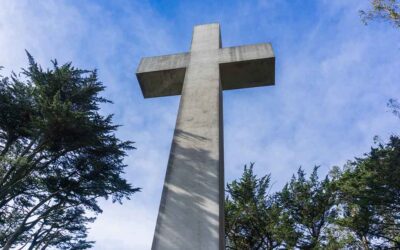
“That increases in migration should be seized on by the extreme right who are bereft of any other ideas is not surprising, although it is less edifying when mainstream parties equivocate in the face of the horrendous violence which migrants suffer. However, from the Churches’ point of view, the more worrying development is the rise of the so–called Christian Right. These groups emphasise what they claim to be the undermining of ‘Christian civilisation’ or ‘Judeao–Christian’ values and the discrimination which they say Christians are subjected to. And they use the Cross – the very epitome of powerlessness, and what a very advanced ‘civilisation’ inflicted on Jesus – as some kind of symbol of their dominance and superiority,” Archbishop McDowell stated.
He asked which aspect of discipleship in Jesus Christ is being exercised by “baying outside a hostel while terrified children are inside. How is parading around the streets draped in a national flag representing the mind of the God of all the nations?”
Previous Posts
Praying Together April 27th 2025
The passage from Matthew’s Gospel gives a warning and example against which every Christian teacher and leader must be tested. As fallen humans, everyone will fall short of perfection– but we can measure lives against it.
Praying Together 20th April 2025
So together, morning, noon and night, we shout Thanks be to God! He gives us the victory through our Lord Jesus Christ.

Praying Together 13th April 2025
He is sinless, we were not – but He takes our sin unto Himself, allowing us the freedom to choose to serve His purpose rather than our own

Praying Together 6th April 2025
Everyone runs in her own way, or his own way. And where does the power come from, to see the race to its end? From within. Jesus said, ‘Behold, the Kingdom of God is within you.
Praying Together 30th March 2025
As Julian of Norwich wrote, ‘the example of a mother’s service is closest, most willing, and most sure because it is most true’, and thus we use that example as part of our Lenten journey.
Praying Together 23rd March 2025
God gives us the freedom to make that choice, and will always offer us another chance when we fail, as He did to the barren fig tree.
Praying Together 16 March 2025
Unlike the other tragic heroes, Jesus has no flaw or blemish other than those inflicted by others: the scars on His back, the thorn-blood on His forehead, the betrayal by His friend.

Praying Together March 9th 2025
God’s demand for perfection need not discourage you in the least in your present attempts to be good, or even in your present failures.

Praying Together 2nd March 2025
God of the nations, whose sovereign rule brings justice and peace, have mercy on our broken and divided world.

Praying Together 23 February 2025
Meditation for the Second Sunday before Lent CollectAlmighty God,you have created the heavens and the earthand made us in your own image:Teach us to discern your hand in all your worksand your likeness in all your children;through Jesus Christ our Lord,who with you...

Praying Together 16th February 2025
And if you accept Him as Lord, allow Him to lead you as you walk into the future without looking back, and do what He has equipped you to do as His body on earth

Praying Together 9th February 2025
We are all asked to have the faith to put out into deep water, but we must remember that we will never be on our own. Peter’s ministry was made possible by the power of the Holy Spirit, as will ours.