

Lent 6 2026
Collect
Most merciful God, who by the death and resurrection of your Son Jesus Christ delivered and saved the world: Grant that by faith in him who suffered on the cross, we may triumph in the power of his victory; through Jesus Christ our Lord.
Matthew 21:1 – 11
When they had come near Jerusalem and had reached Bethphage, at the Mount of Olives, Jesus sent two disciples, saying to them, ‘Go into the village ahead of you, and immediately you will find a donkey tied, and a colt with her; untie them and bring them to me. If anyone says anything to you, just say this, “The Lord needs them.” And he will send them immediately.’* This took place to fulfil what had been spoken through the prophet, saying,
‘Tell the daughter of Zion, Look, your king is coming to you, humble, and mounted on a donkey, and on a colt, the foal of a donkey.’
The disciples went and did as Jesus had directed them; they brought the donkey and the colt, and put their cloaks on them, and he sat on them. A very large crowd* spread their cloaks on the road, and others cut branches from the trees and spread them on the road. The crowds that went ahead of him and that followed were shouting,
‘Hosanna to the Son of David! Blessed is the one who comes in the name of the Lord! Hosanna in the highest heaven!’
When he entered Jerusalem, the whole city was in turmoil, asking, ‘Who is this?’ The crowds were saying, ‘This is the prophet Jesus from Nazareth in Galilee.’
Matthew 27:27 – 44
The governor’s soldiers took Jesus into the Praetorium and gathered the whole company of soldiers around him. They stripped him and put a scarlet robe on him, and then twisted together a crown of thorns and set it on his head. They put a staff in his right hand. Then they knelt in front of him and mocked him. “Hail, king of the Jews!” they said. They spat on him, and took the staff and struck him on the head again and again. After they had mocked him, they took off the robe and put his own clothes on him. Then they led him away to crucify him.
As they were going out, they met a man from Cyrene, named Simon, and they forced him to carry the cross. They came to a place called Golgotha (which means “the place of the skull”). There they offered Jesus wine to drink, mixed with gall; but after tasting it, he refused to drink it. When they had crucified him, they divided up his clothes by casting lots. And sitting down, they kept watch over him there. Above his head they placed the written charge against him: this is Jesus, the king of the Jews.
Two rebels were crucified with him, one on his right and one on his left. Those who passed by hurled insults at him, shaking their heads and saying, “You who are going to destroy the temple and build it in three days, save yourself! Come down from the cross, if you are the Son of God!” In the same way the chief priests, the teachers of the law and the elders mocked him. “He saved others,” they said, “but he can’t save himself! He’s the king of Israel! Let him come down now from the cross, and we will believe in him. He trusts in God. Let God rescue him now if he wants him, for he said, ‘I am the Son of God.’” In the same way the rebels who were crucified with him also heaped insults on him.
Our two readings from the Gospel take place within only a few days – yet they could not be more different. In one, the crowd are waving palms and greeting Jesus as the Son of God, the Promised one – less than a week later, that same crown are baying for His death, provoked by self-regarding leaders who even admit their machinations: “You don’t realize that it is better for you to have one man die for the people than to have the whole nation destroyed”, says Caiaphas in John 11:50. He is thinking of pacifying the Roman Occupiers and preventing rebellion – but despite his learning, he doesn’t realise that the prophesied Messiah is given to the world, not just the Jews, the ‘chosen ones’. The ‘One Man’ he mentions, who happens to be the Son of God, will die for every woman, man and child in all of creation.
People often ask the question Why did Jesus have to die? I came across the following from a Christian philosopher, Alan Dotchin, who succinctly discusses the various theological replies:
In Christian theology, the crucifixion is not merely a martyrdom or political execution; it is the central act of God’s redemptive plan for humanity. Several key doctrines stem from this belief:
1. Atonement
The doctrine of atonement teaches that Jesus’ death paid the penalty for human sin, reconciling humanity with God. As the “Lamb of God” (John 1:29), Jesus’ sacrifice is seen as the fulfilment of Old Testament sacrificial practices.
2. Substitution and Sacrifice
Jesus is often seen as a substitute, taking upon himself the punishment deserved by others. As Isaiah 53 prophesied, “He was pierced for our transgressions.”
3. Victory over Sin and Death
In the Christus Miles (Christ the soldier) model, Jesus’ death and resurrection represent a victory over the powers of sin, death, and evil. The cross is not defeat—it is triumph.
4. Love and Grace
The crucifixion is viewed as the ultimate demonstration of divine love. As John 3:16 proclaims: “For God so loved the world that he gave his only Son.” The cross reveals a God who suffers with and for humanity.
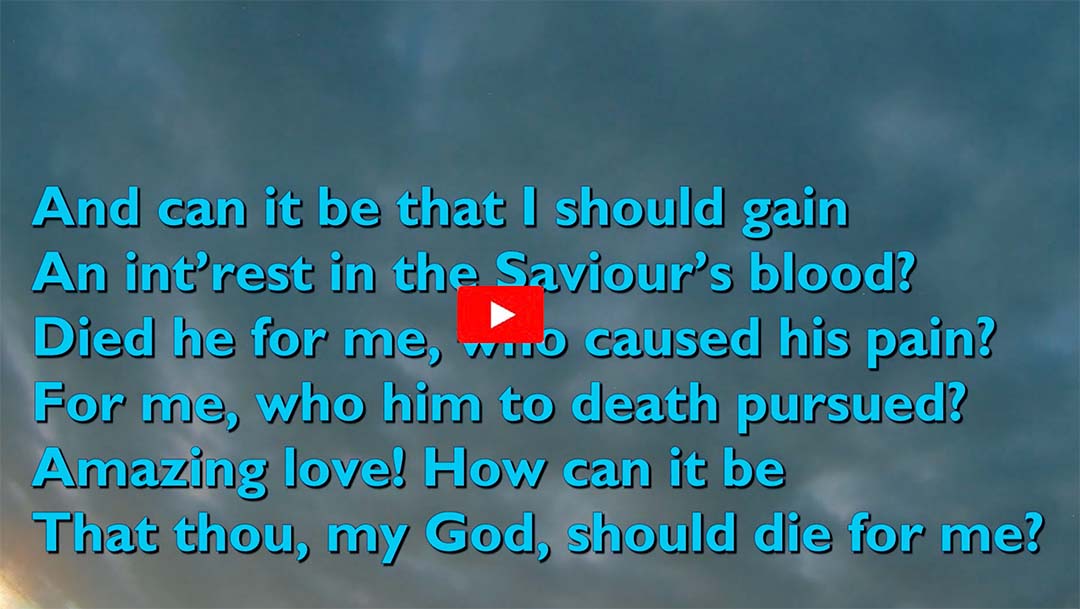
These things are worth meditation and thought, as we enter this Holy Week – but the even more important question that we can only answer for ourselves, is embodied in twelve straightforward words written by Charles Wesley.
How can it be, That Thou, my God, shouldst die for me?
Previous Posts

Praying Together 28th July 2024
Trinity 9CollectAlmighty God, who sent your Holy Spirit to be the life and light of your Church: Open our hearts to the riches of his grace, that we may bring forth the fruit of the Spirit in love and joy and peace; through Jesus Christ our Lord. Ephesians 3:...

Praying Together 21st July 2024
It is all too easy to look at the speck in another’s eye while ignoring the plank in our own. We live in God’s created world with many different people; but when it comes down to it, we are all His children, brothers and sisters.

Praying Together 14th July 2024
If there is no laughter, Jesus has gone somewhere else. If there is no joy and freedom, it is not a church.

Praying Together 7th July 2024
Be blessed to (and be prepared for) whatever you are called this day, in His name, however unexpected!

Praying Together 30th June 2024
Jesus’ healing is a signpost pointing to the culmination of His divine mission, that encompasses His suffering and torture, His death, His triumph over sin through His cross, and the defeat of evil in His resurrection.

Praying Together 23rd June 2024
It wasn’t only the wind and sea that will obey Him – the whole of heaven and earth will kneel before Him as Lord.

Praying Together 16th June 2024
The stories used by Jesus to explain the Kingdom of heaven – the ‘parables’ – offer understandable truth to all of them whoever they may be– and through many generations, to us.

Praying Together 9th June 2024
If we just give in and believe that there is nothing we can do to bring about such a change, the dream will never come true. So let’s not.

Praying Together 2nd June 2024
You may remember the song: ‘It ain’t what you do it’s the way that you do it, that’s what gets results.’ Catchy tune, catchy title. But wrong. Actually, it’s the other way round – ‘It ain’t the way that you do it, it’s what you do…’

Praying Together 19th May 2024
By the power of the same Spirit strengthen us to witness to your truth and to draw everyone to the fire of your love; through Jesus Christ our Lord.

Praying Together 12th May 2024
But in Christ, a much more reliable ‘Truth’ can be found. Truth in the ‘Logos’ – the Word. The Word made flesh.

Praying Together 5th May 2024
Collect for Easter 6 God our redeemer, you have delivered us from the power of darkness and brought us into the kingdom of your Son: Grant, that as by his death he has recalled us to life, so by his continual presence in us he may raise us to eternal joy; through...