Rev Michael Cavanagh +353 (0)87 160 6312
Praying Together 21st September 2025

Praying Together 21st September 2025

So the commandment is a challenge. To love those who betray you. Those who jeer. Those who wield the whips embedded with flint, hammer in the nails, pierce your side.

Meditation for Trinity 14 2025

Collect

Almighty God, whose only Son has opened for us a new and living way into your presence: Give us pure hearts and steadfast wills to worship you in spirit and in truth, through Jesus Christ our Lord.

Luke 16: 1 – 14

Then Jesus said to the disciples, ‘There was a rich man who had a manager, and charges were brought to him that this man was squandering his property. So he summoned him and said to him, “What is this that I hear about you? Give me an account of your management, because you cannot be my manager any longer.” Then the manager said to himself, “What will I do, now that my master is taking the position away from me? I am not strong enough to dig, and I am ashamed to beg. I have decided what to do so that, when I am dismissed as manager, people may welcome me into their homes.” So, summoning his master’s debtors one by one, he asked the first, “How much do you owe my master?” He answered, “A hundred jugs of olive oil.” He said to him, “Take your bill, sit down quickly, and make it fifty.” Then he asked another, “And how much do you owe?” He replied, “A hundred containers of wheat.” He said to him, “Take your bill and make it eighty.” And his master commended the dishonest manager because he had acted shrewdly; for the children of this age are more shrewd in dealing with their own generation than are the children of light. And I tell you, make friends for yourselves by means of dishonest wealth so that when it is gone, they may welcome you into the eternal homes.

‘Whoever is faithful in a very little is faithful also in much; and whoever is dishonest in a very little is dishonest also in much. If then you have not been faithful with the dishonest wealth, who will entrust to you the true riches? And if you have not been faithful with what belongs to another, who will give you what is your own? No slave can serve two masters; for a slave will either hate the one and love the other, or be devoted to the one and despise the other. You cannot serve God and money.’

The Pharisees, who were lovers of money, heard all this, and they scoffed at him.

A tale of two scoundrels

The first rule of telling an effective story is knowing your audience. Luke says that Jesus is telling this well-known story to His disciples – but the audience Jesus is really talking to is actually not the group of disciples, but the Jewish leadership who are listening in, waiting for the opportunity to condemn Jesus for insulting the religious leadership.

In the story, the manager has been incompetent. His job was to invest his rich bosses’ money and deliver a sizeable return, driving a hard bargain with his suppliers. Clearly, he wasn’t even clever enough to disguise his poor performance, and when he is found out, he looks to buy himself friends for after he will inevitably get sacked. He makes a deal with the debtors. (I wonder if they intend to keep their part of the bargain?)

Again, he is found out. He is summoned to account for his actions – but is astounded when instead of receiving punishment, he is praised for his initiative. His boss has himself achieved his riches through underhand methods, and recognises a fellow thief. The manager breathes a sigh of relief – but doesn’t realise that he is now beholden for ever with the threat of his dishonesty being revealed unless he does whatever he is told. Blackmail on the cards if he ever doesn’t do what his master wants. He’s on the slippery slope and there’s no way back. And through complying with his dodgy dealing, the debtors also become accessories after the fact – they can be blackmailed and their lies made public at any time.

The stories Jesus tells are usually metaphorical, and this is no exception. His hearers – including the Pharisees – know what He is really saying. In the story, the rich man is the Satan; the unfaithful manager is a Pharisee; and the debtors are the people the religious authorities capture into the net of their corruption. The vehicle the Satan uses to ensnare them all is greed. Their love of money blinds them to the sinfulness of their actions.

‘…make friends for yourselves by means of dishonest wealth so that when it is gone, they may welcome you into the eternal homes…’ says Jesus with a touch of sarcasm – the eternal home being Hell. Or choose truth – and live in His Kingdom.

Previous Posts

Praying Together 14th September 2025

Praying Together 14th September 2025

So the commandment is a challenge. To love those who betray you. Those who jeer. Those who wield the whips embedded with flint, hammer in the nails, pierce your side.

Meditation for Trinity 13 2025

Collect

Almighty God, who called your Church to bear witness that you were in Christ reconciling the world to yourself: Help us to proclaim the good news of your love, that all who hear it may be drawn to you; through him who was lifted up on the cross, and reigns with you and the Holy Spirit, one God, now and for ever.

Timothy 1: 12 – 17

I am grateful to Christ Jesus our Lord, who has strengthened me, because he judged me faithful and appointed me to his service, even though I was formerly a blasphemer, a persecutor, and a man of violence. But I received mercy because I had acted ignorantly in unbelief, and the grace of our Lord overflowed for me with the faith and love that are in Christ Jesus. The saying is sure and worthy of full acceptance, that Christ Jesus came into the world to save sinners—of whom I am the foremost. But for that very reason I received mercy, so that in me, as the foremost, Jesus Christ might display the utmost patience, making me an example to those who would come to believe in him for eternal life. To the King of the ages, immortal, invisible, the only God, be honour and glory for ever and ever. Amen

I received mercy because I had acted ignorantly in unbelief…

Paul doesn’t try to justify his previous actions – blasphemer, persecutor, man of violence. He merely asserts that is deeds were performed out of ignorance of the truth of the incarnation of God’s only Son, Jesus, the promised Christ. Once he met with Jesus on the Damascus Road, he now knows that truth – and in accepting the Christ, through grace, his violent sinful past is left at the foot of the Cross.

Two questions, then. Is ignorance of the Law an excuse for the things people have done? In secular common law, the answer is no. The principle is ‘ignorantia juris non excusat’ – ‘ignorance of the law is no excuse.’

This is reflected in the Old Testament: Leviticus 5:17: “And if any one sin, and do any of the things which Jehovah hath commanded not to be done; though he knew it not, yet is he guilty, and shall bear his iniquity

And in the New Testament: Romans 1:18-20 provides a foundational text for this doctrine: “… since the creation of the world God’s invisible qualities—His eternal power and divine nature—have been clearly seen, being understood from what has been made, so that people are without excuse.”
Paul admits he should have known better, but it took the dramatic Damascus Road experience to convict him.

There is no excuse, he says – God is visible in all creation, and we know it if we simply look around us. This is called ‘natural law’. Encyclopaedia Brittanica: ‘Natural law is a philosophical concept that refers to a system of right or justice believed to be morally universal and inherent to human nature, rather than established by societal rules or positive law.’ In other words, we know right from wrong. We don’t have to be told.

This is different to ‘positivist law’ – a set of rules laid down by an authority (religious or secular) which have no integral moral base and are accepted by the society they lead whether just or unjust.

Paul realised that positivist obedience to the human-derived interpretation of the Commandments will never result in salvation. He became aware that he had sinned and was called to repent and ask forgiveness. Like him, we know that the gift of freedom comes only through Christ and the Cross He climbs. The past is past. We walk away from the tomb into freedom. Every time we fail. But then we are given the opportunity to start again.

The second question is more difficult. So, if you are not ‘ignorant’ any longer, if you know the truth but continue to sin, what are the consequences? Are you refusing the free gift of Grace? And if you refuse it, what happens? Dramatic as literary depictions of the fiery furnace of hell might be, I don’t think they describe the reality. Instead, I believe that hell is the consequence of you choosing to be locked out of God’s love, for eternity – finally knowing the truth and realising it’s too late to change your mind. You had your opportunities – many opportunities – in your earthly life. It didn’t matter what you had been, said or done – like Paul, you were given the chance to repent. You didn’t.

Previous Posts

Praying Together 7th September 2025

Praying Together 7th September 2025

So the commandment is a challenge. To love those who betray you. Those who jeer. Those who wield the whips embedded with flint, hammer in the nails, pierce your side.

Meditation for Trinity 12 2025

Almighty and everlasting God, you are always more ready to hear than we to pray and to give more than either we desire, or deserve:

Pour down upon us the abundance of your mercy, forgiving us those things of which our conscience is afraid, and giving us those good things which we are not worthy to ask save through the merits and mediation of Jesus Christ your Son our Lord.

Luke 14: 25 – 33

Now large crowds were travelling with him; and he turned and said to them, ‘Whoever comes to me and does not hate** father and mother, wife and children, brothers and sisters, yes, and even life itself, cannot be my disciple. Whoever does not carry the cross and follow me cannot be my disciple. For which of you, intending to build a tower, does not first sit down and estimate the cost, to see whether he has enough to complete it? Otherwise, when he has laid a foundation and is not able to finish, all who see it will begin to ridicule him, saying, “This fellow began to build and was not able to finish.” Or what king, going out to wage war against another king, will not sit down first and consider whether he is able with ten thousand to oppose the one who comes against him with twenty thousand? If he cannot, then, while the other is still far away, he sends a delegation and asks for the terms of peace. So therefore, none of you can become my disciple if you do not give up all your possessions.

**N.B. the word used is μισέω (miseō) – which literally means ‘To love less, or to prefer someone or something less than another’ – to translate the word as ‘hate’ implies anger and that is not a valid translation in this context.

er… can I just keep my stamp collection?

No.

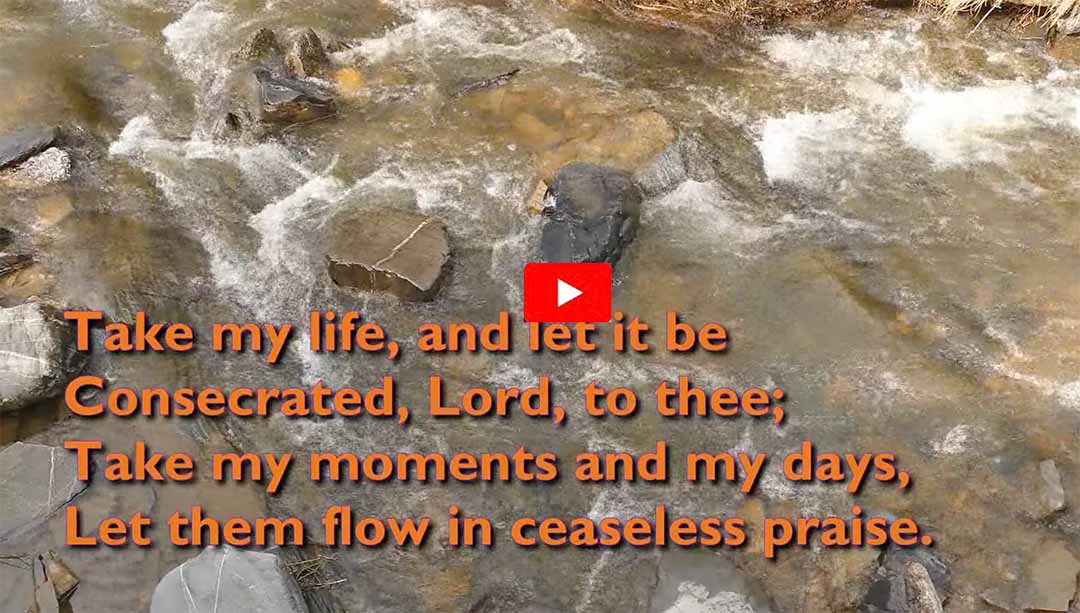
Looking for a video for this week’s meditation, I found lots of versions. Most of them were missing a verse. Guess which.

Yup. You got it. The one that begins ‘Take my Silver and my Gold…’

The hymn ‘Take my life’ may possibly be the most difficult in the Hymn book to sing with sincerity. Just look again at what we are asking.

Take my life,
Take my hands,
Take my feet,
Take my voice,
Take my lips,
Take my silver and my gold,
Take my intellect,
Take my will,
Take my heart,
Take my love,
Take myself.

You will notice there are no exclusions. Take my everything, we ask.

Every single thing I am.

So, if we truly offer Him everything, does that leave us with nothing? Quite the opposite. When we give our life to Jesus, it includes the bad bits as well as the good bits. And it is given back to us, sparkling clean and pure. At no cost to ourselves other than a promise to now take on the role of being the body of Christ on Earth, in all we do and say.

And yes, we will find that to be an impossible challenge – but one to which we aspire, with heart and mind and soul (and all the others mentioned above). We miss the mark. Often. Fortunately, and blessedly, we can always sing that hymn again. The Lord will never tire to hear it and respond in unending sacrificial love.

Previous Posts

Praying Together 31st August 2025

Praying Together 31st August 2025

So the commandment is a challenge. To love those who betray you. Those who jeer. Those who wield the whips embedded with flint, hammer in the nails, pierce your side.

Meditation for Trinity 11 2025

Luke 14: 1, 7 – 14

On one occasion when Jesus was going to the house of a leader of the Pharisees to eat a meal on the sabbath, they were watching him closely.

When he noticed how the guests chose the places of honour, he told them a parable. ‘When you are invited by someone to a wedding banquet, do not sit down at the place of honour, in case someone more distinguished than you has been invited by your host; and the host who invited both of you may come and say to you, “Give this person your place”, and then in disgrace you would start to take the lowest place. But when you are invited, go and sit down at the lowest place, so that when your host comes, he may say to you, “Friend, move up higher”; then you will be honoured in the presence of all who sit at the table with you. For all who exalt themselves will be humbled, and those who humble themselves will be exalted.’

He said also to the one who had invited him, ‘When you give a luncheon or a dinner, do not invite your friends or your brothers or your relatives or rich neighbours, in case they may invite you in return, and you would be repaid. But when you give a banquet, invite the poor, the crippled, the lame, and the blind. And you will be blessed, because they cannot repay you, for you will be repaid at the resurrection of the righteous.’

You’re invited to a banquet. There will be people you know, people you don’t. Some will be ViPs – some personal friends of the host; there will be those invited for protocol reasons; some out of gratitude for past deeds. You don’t feel comfortable – you feel you don’t deserve to be there at all. So you want to make a good impression and not embarrass yourself by making a faux pas (or several of them), so you Google ‘Banquet etiquette’, and there are pages and pages of advice (Google returned 17,800 hits), ranging from ‘don’t start eating before the host’ through ‘don’t drink the soup as if it were in a glass’ to ‘don’t wear white to a wedding’ and ‘Don’t move the place cards around so you can sit with people you like’. (More on this last one later)

I know someone who would like to add at least one addition for a serve-yourself buffet – ‘If you’re a carnivore, don’t pig out on the veggie option because it looks tasty and interesting before the actual vegetarians have a chance to grab something – if there’s actually going to be any left’’. (This was spoken from experience).

When Jesus was invited to the Pharisee leader’s house (in itself a significant event, demonstrating that Jesus was taken seriously, not ignored as an uneducated itinerant preacher from the sticks), he sees a game of musical chairs taking place. Local dignitaries are jostling for position to be recognised as significant figures in the hierarchy, and want to be seen at the top table next to the host. They consider themselves more important than the rest of the hoi polloi. We all know people like that. We see them on the 6 o’clock news every evening.

In their self-importance, they think they deserve the best seat at the table and are prepared to elbow their way to their objective. This is true to their belief that they will always enjoy the Executive seats wherever they travel. Not just at the banquet set before them at the Pharisees house, but at the supper at God’s right hand. As the song said, it’s hard to be humble when you’re perfect in every way, and they consider that they are entitled to be served first.

When they get there they will expect a seating plan with their name in Copperplate lettering, next to their equally ‘important’ peers. But instead they are just as likely to be placed next to me. Or You. Or any one of the millions of others of disciples. The heavenly banquet has only one rule of etiquette – That you accept Jesus , the Christ, as Saviour and Redeemer. And then your place and theirs is at the head of His table, alongside Him.

You know and He knows you don’t ‘deserve’ to be. But He loves you anyway. So your table’s waiting. Enjoy the feast.

Previous Posts

Praying Together 24th August 2025

Praying Together 24th August 2025

So the commandment is a challenge. To love those who betray you. Those who jeer. Those who wield the whips embedded with flint, hammer in the nails, pierce your side.

Meditation for Trinity 10 2025

Hebrews 12: 18 – 29

You have not come to something that can be touched, a blazing fire, and darkness, and gloom, and a tempest, and the sound of a trumpet, and a voice whose words made the hearers beg that not another word be spoken to them. (For they could not endure the order that was given, ‘If even an animal touches the mountain, it shall be stoned to death.’ Indeed, so terrifying was the sight that Moses said, ‘I tremble with fear.’)

But you have come to Mount Zion and to the city of the living God, the heavenly Jerusalem, and to innumerable angels in festal gathering, and to the assembly of the firstborn who are enrolled in heaven, and to God the judge of all, and to the spirits of the righteous made perfect, and to Jesus, the mediator of a new covenant, and to the sprinkled blood that speaks a better word than the blood of Abel.

See that you do not refuse the one who is speaking; for if they did not escape when they refused the one who warned them on earth, how much less will we escape if we reject the one who warns from heaven! At that time his voice shook the earth; but now he has promised, ‘Yet once more I will shake not only the earth but also the heaven.’ This phrase ‘Yet once more’ indicates the removal of what is shaken—that is, created things—so that what cannot be shaken may remain. Therefore, since we are receiving a kingdom that cannot be shaken, let us give thanks, by which we offer to God an acceptable worship with reverence and awe; for indeed our God is a consuming fire.

Luke 13: 29 – 10: 17

Now he was teaching in one of the synagogues on the sabbath. And just then there appeared a woman with a spirit that had crippled her for eighteen years. She was bent over and was quite unable to stand up straight. When Jesus saw her, he called her over and said, ‘Woman, you are set free from your ailment.’ When he laid his hands on her, immediately she stood up straight and began praising God. But the leader of the synagogue, indignant because Jesus had cured on the sabbath, kept saying to the crowd, ‘There are six days on which work ought to be done; come on those days and be cured, and not on the sabbath day.’ But the Lord answered him and said, ‘You hypocrites! Does not each of you on the sabbath untie his ox or his donkey from the manger, and lead it away to give it water? And ought not this woman, a daughter of Abraham whom Satan bound for eighteen long years, be set free from this bondage on the sabbath day?’ When he said this, all his opponents were put to shame; and the entire crowd was rejoicing at all the wonderful things that he was doing.

Tick-in-the-box religion or love-in-action?

For the most part, the Epistle to the Hebrews does more or less what it says on the tin – but it isn’t addressed to every Israelite, only those who have accepted Jesus as the Messiah. In order for them to gain a deeper insight into their new faith, it explains the doctrinal difference between the Old and New Covenants, and assumes a knowledge of the former on which to base the Christian understanding of God’s relationship with His people. It has been suggested (slightly tongue in cheek, but quite accurately), that the Book of Hebrews was written by a Hebrew to other Hebrews telling the Hebrews to stop acting like Hebrews. It rejects ‘religion’ in its discussion of faith and salvation – that gift comes through grace alone. In today’s readings, it talks about two mountains.

Sinai represents the unapproachable Old Covenant Mountain, on which God gives to Moses the series of laws by which Israel is commanded to live. But it shows that it is demonstrably impossible to live by the law in itself and thus achieve salvation – humans, however pious, are still subject to sin and tremble with fear as they realise the power of the untouchable and unclimbable mountain.

Instead, through Christ, the mountain we are offered is Zion – The New Covenant home, established through the life, death, and resurrection of Jesus Christ, characterised by the internalization of God’s laws and obedience to the simple commandment to love God and our neighbour as we are loved through Christ.

Luke’s story of the healing of the crippled woman shows the significance of this difference in action. The leader of the synagogue wants to get a tick in the box; Jesus wants to heal. That isn’t to say the Priest is being malevolent – probably, he sincerely feels that Jesus is committing a rebellious – if not even blasphemous – act, that risks undermining his authority and position in the social hierarchy. He is only being true to his belief in the Mosaic Law as the foundation of Jewish society. Unfortunately, that belief has in itself become an idol, an object of worship, a closed-mind barrier to the truth. He can’t – won’t – hear Jesus. His hypocritical behaviour goes back to those Israelites in the foothills of Sinai who persuaded Aaron to make a metal image of a calf for their worship, causing Moses to shatter the stone tablets holding the commandments which God had given him. Through the ages, the story is the same – people want a god of their own design, with empty ‘religious’ rituals they can perform and then get on with their life, rather than the simple (but at the same time difficult) command to put love into action – a life not of religious prestige, but continuous humble service.

A human-designed religion doesn’t work in achieving salvation. Human nature and human sin renders it impossible. Salvation does not ever come through religious practice – it comes through Christ, the only sinless one, whose sacrifice is given as a free gift in love, to those who can’t help themselves. All He asks is that we are open to respond to His word in penitence and faith, and then His amazing Grace lifts us to the Mountain peak from which we go forth as Christ’s body to heal a broken world.

N.B. In the epistle, the angel-accompanied ascent to Mount Zion – the Heavenly Jerusalem – is not to be confused with ‘Zionism’, a political movement dating from the late nineteenth century which aspires to combine secular nationalism and religious conservatism in order to create an exclusively Jewish homeland.

Previous Posts

Paying Together 17th August 2025

Paying Together 17th August 2025

So the commandment is a challenge. To love those who betray you. Those who jeer. Those who wield the whips embedded with flint, hammer in the nails, pierce your side.

Meditation for Trinity 9 2025

Collect

Almighty God, who sent your Holy Spirit to be the life and light of your Church:
Open our hearts to the riches of his grace, that we may bring forth the fruit of the Spirit in love and joy and peace; through Jesus Christ our Lord.

Isaiah 5: 1 – 7

Let me sing for my beloved, my love-song concerning his vineyard:
My beloved had a vineyard on a very fertile hill. He dug it and cleared it of stones, and planted it with choice vines; he built a watch-tower in the midst of it, and hewed out a wine vat in it; he expected it to yield grapes, but it yielded wild grapes.

And now, inhabitants of Jerusalem and people of Judah, judge between me
and my vineyard. What more was there to do for my vineyard that I have not done in it? When I expected it to yield grapes, why did it yield wild grapes?

And now I will tell you what I will do to my vineyard. I will remove its hedge, and it shall be devoured; I will break down its wall, and it shall be trampled down. I will make it a waste; it shall not be pruned or hoed, and it shall be overgrown with briers and thorns; I will also command the clouds that they rain no rain upon it.

For the vineyard of the Lord of hosts is the house of Israel, and the people of Judah are his pleasant planting; he expected justice, but saw bloodshed;
righteousness, but heard a cry!

Hebrews 11: 29 – 12: 2

By faith the people passed through the Red Sea as if it were dry land, but when the Egyptians attempted to do so they were drowned. By faith the walls of Jericho fell after they had been encircled for seven days. By faith Rahab the prostitute did not perish with those who were disobedient, because she had received the spies in peace.

And what more should I say? For time would fail me to tell of Gideon, Barak, Samson, Jephthah, of David and Samuel and the prophets— who through faith conquered kingdoms, administered justice, obtained promises, shut the mouths of lions, quenched raging fire, escaped the edge of the sword, won strength out of weakness, became mighty in war, put foreign armies to flight. Women received their dead by resurrection. Others were tortured, refusing to accept release, in order to obtain a better resurrection. Others suffered mocking and flogging, and even chains and imprisonment. They were stoned to death, they were sawn in two, they were killed by the sword; they went about in skins of sheep and goats, destitute, persecuted, tormented— of whom the world was not worthy. They wandered in deserts and mountains, and in caves and holes in the ground.

Yet all these, though they were commended for their faith, did not receive what was promised, since God had provided something better so that they would not, without us, be made perfect.

Therefore, since we are surrounded by so great a cloud of witnesses, let us also lay aside every weight and the sin that clings so closely, and let us run with perseverance the race that is set before us, looking to Jesus the pioneer and perfecter of our faith, who for the sake of the joy that was set before him endured the cross, disregarding its shame, and has taken his seat at the right hand of the throne of God.

Luke 12: 49 – 56

‘I came to bring fire to the earth, and how I wish it were already kindled! I have a baptism with which to be baptized, and what stress I am under until it is completed! Do you think that I have come to bring peace to the earth? No, I tell you, but rather division! From now on, five in one household will be divided, three against two and two against three; they will be divided:
father against son
   and son against father,
mother against daughter
   and daughter against mother,
mother-in-law against her daughter-in-law
   and daughter-in-law against mother-in-law.’

He also said to the crowds, ‘When you see a cloud rising in the west, you immediately say, “It is going to rain”; and so it happens. And when you see the south wind blowing, you say, “There will be scorching heat”; and it happens. You hypocrites! You know how to interpret the appearance of earth and sky, but why do you not know how to interpret the present time?

Three readings from scripture – and none of them really suitable for a recruitment poster for Christianity… …just one offering a promise that despite suffering and torture, there will be what has been cynically called ‘Pie in the Sky when you Die’. Not exactly evidence that would stand up in a court of law.

Isaiah says that Israel has been given a beautiful vineyard, but has turned it into a bloodstained wasteland, the consequences of which will be exile. They didn’t learn then – apparently they still haven’t. Neither, to their shame, has the rest of the world.

The writer to the Hebrews gives examples of the potential persecution to be experienced when people choose to live by faith – and that their reward will not be of this world, but when we eventually take our place in the heavenly kingdom. That faith will be tested to the limit, but it will be the only way to survival.

Jesus warns the people that they are ignoring the signs of impending conflict and division, in which families will be torn apart. They consider themselves so clever in wordly knowledge but fail to see the wider picture. The result will be personal disaster.

We look at the world in which we live today, recognise all these situations, and feel increasingly helpless in the face of endless violence and conflict. But we are not. The call from the writer to the Hebrews is a call to faith, and we are challenged to choose to comply.

In faith, we give thanks for the beauty of the vineyard, and accept our responsibility to speak out against those who would destroy it.  

In faith, we look to Jesus and choose to follow Him despite the possible consequence and disturbance of our well-being. We refuse to allow sincere difference of opinion to degrade into prejudice or violence.

In faith, we give thanks for those who have gone before and whose faith inspires us to follow their example.

And most importantly, we ask that our faith is strengthened in the power of the Spirit when it is tested – and that we will have the courage to live as the Body of Christ, who alone offers life.

Previous Posts